
As Americans navigate a tumultuous political, economic, and social landscape, NPPC continues to advocate for dignified, secure retirement plans for public servants from coast to coast–because the promise of guaranteed lifetime income following a career of service is one aspect of the American dream that we believe can still come true.
Our state coalitions work relentlessly to ensure that public services flourish under the flush of dedicated, qualified, adequately compensated public servants. Here’s a look forward at some of the challenges our state partners are facing in 2026 as they continue to advocate for retirement security:
Alaska: State Legislature convenes January 20, 2026
In 2025, legislation for a new defined benefit pension for Alaska’s public employees passed the Alaska House and is poised for Senate action in 2026. HB 78 will navigate the Labor and Commerce and Finance committees, then move on to the Senate floor for a vote. Labor-friendly lawmakers in the Senate are endorsing HB 78 as a common-sense solution to the ongoing recruitment and retention crisis in public employment that has crippled public services, leaving not only Alaska’s most vulnerable populations but every community across the state at risk.
A wide coalition of Alaskans, including the business community, municipal leaders from throughout Alaska, and the state AARP, all agree that this legislation is an absolute necessity for the state to attract and retain enough skilled workers to provide basic public services, such as public education, police and fire protection, and infrastructure maintenance. Without a comprehensive compensation package, vital employees will continue to leave the Alaskan public sector or avoid it altogether.
As for obstacles, the coalition expects continued interference from Americans for Prosperity Alaska and its partners, such as the Reason Foundation, Equable, the Heritage Foundation, and the Alaska Policy Forum, to kill this bill. Additionally, Governor Mike Dunleavy has previously opposed pension restoration and demonstrated a willingness to veto broadly supported legislation, so when the bill passes the Senate, a gubernatorial veto is possible.
Ultimately, the fate of DB pensions in Alaska will likely remain unresolved until election season later this year, with candidates on both sides of the aisle lining up to replace Dunleavy. Aside from the most ideologically extreme among the group, most major candidates, Republicans and Democrats alike, support returning to the same kind of secure retirement Dunleavy himself enjoys.
Arizona: State Legislature convened January 12, 2026
In 2025, the Arizona state legislature addressed several attacks on the system that involved proxy advisory firms, investments, and divestment threats. While these incursions were not overt threats to close the DB plans, Arizona is emblematic of a new type of challenge our state partners face, as debates evolve to match the national political landscape. In 2026, the coalition is prepared to face similar bids to dismantle retirement security through the Arizona State Retirement System (ASRS).
A number of potential scenarios could spark a significant pension fight in Arizona, including proposals for defined contribution or hybrid plans for new ASRS hires, reforms to restructure the current plan, and continued divestment and proxy advisory firm legislation. Efforts to curb the legislative influence of anti-pension organizations such as the Reason Foundation and Americans for Prosperity remain a top priority.
Colorado: State Legislature convenes January 14, 2026
Colorado is up against significant fiscal challenges this year, including a projected budget shortfall that could require up to $1 billion in cuts. These cuts could impact the state’s $225 million annual commitment to the Public Employees’ Retirement Association (PERA). Governor Jared Polis has already proposed reducing the state’s contribution to the Colorado Public Employees’ Retirement Association by up to $38 million as part of his budget plan for FY 2026–27, so coalition allies are gearing up to protect pension funding.
Since the landmark SB18-200 reforms, which established the required annual state contribution and automatic adjustments for future shortfalls, among other reforms, were enacted in 2018, much of the legislature has turned over. Hence, education and leadership development within the current class of lawmakers is imperative to PERA’s success. Emphasising the critical impact pensions have on recruitment, retention, and retirement security remains a significant objective for 2026.
The coalition will also partner with PERA leadership to develop policy that reduces unfunded liabilities without additional participant or taxpayer burden, and explore options for meaningful financial relief for current retirees.
Connecticut: State Legislature convenes February 4, 2026
Connecticut continues to face threats from anti-labor organizations and politicians that target workers’ rights to retire with a pension. In 2025, some legislators took aim at overtime in state employment, attempting to pit private-sector employees against public employees. Triggering rhetoric over so-called pension spiking in the Department of Corrections–one of the most demanding, understaffed, overworked departments in the state– the Yankee Institute was also active in 2025, spewing misinformation in local media and pushing its pro-capitalist, anti-labor propaganda.
Significant financial upheaval in the 2010s prompted lawmakers in the Nutmeg State to create a new pension tier that raised the retirement age, increased employee contributions, and reduced employee payouts. However, ongoing talks with Governor Lamont’s administration to address potential changes to Tier IV aim to restore a competitive state compensation program and improve recruitment and retention rates. In addition, the State Employees Bargaining Agents Coalition (SEBAC) is due to renegotiate an agreement with the state on pension and healthcare in 2027, placing extra emphasis on the vital role retirement security plays in employee satisfaction and public services.
Iowa: State Legislature convenes January 12, 2026
In Iowa, retirement security for public employees is at a critical crossroads in 2026. Last year, allies fended off efforts to replace IPERS with defined-contribution or hybrid plans that mimic 401(k)-style risk and undermine retirees’ lifetime income security. The proposal has roots in a state-level DOGE committee tasked with making the state government more like a business. Iowa’s public pension coalition sounded the alarm that a shift toward individual-risk retirement accounts could destabilize the state’s retirement ecosystem.
Recognizing these threats, Iowa House Democrats have announced plans to introduce a constitutional amendment during the 2026 legislative session to protect IPERS from future legislative actions that would weaken or dismantle the traditional pension structure. This proposal aims to enshrine pension security in the Iowa Constitution, making it more difficult for future lawmakers to pass destabilizing reforms and giving retirees greater confidence that their earned benefits will be safeguarded.
Kansas: State Legislature convened January 12, 2026
Since the late 2010s, Kansas lawmakers have seen efforts to inject the concept of the Federal Public Employee Thrift Savings Retirement plan into Kansas public pension policy. Originally based on model legislation from the anti-labor, anti-pension American Legislative Exchange Council (ALEC), State Senator Caryn Tyson, who chairs the Senate Assessment and Taxation Committee, has been the primary champion of this legislation in the past, and 2025 was no exception. Rebranded as K.R.I.S.P. (Kansas Retirement Investment Savings Plan), Sen. Tyson’s proposal did not advance during the 2025 session. Still, it is a holdover bill and is therefore eligible for further consideration in 2026.
The governor’s race in Kansas may also play a role in Kansas’s pension framework, as the state bids farewell to term-limited Governor Laura Kelly in 2027. A long-time advocate for KPERS, Kelly’s departure opens the door for candidates who have a history of promoting 401(k) style retirement programs for public employees. This would put KPERS at risk and likely undermine ongoing, methodical efforts to improve Tier 3.
A 2023 Legislative Post Audit indicated that the income replacement ratios in KPERS Tier 3 are grievously inadequate, particularly when compared to benefit offerings in neighboring states. While lawmakers have recognized the need for improvement, without a consensus on an approach, Sen. Tyson’s thrift savings proposal could gain traction. However, Kansas state coffers ended 2025 on a positive note, making Tier 3 improvements more accessible than ever.
Kentucky: State Legislature convenes January 6, 2026
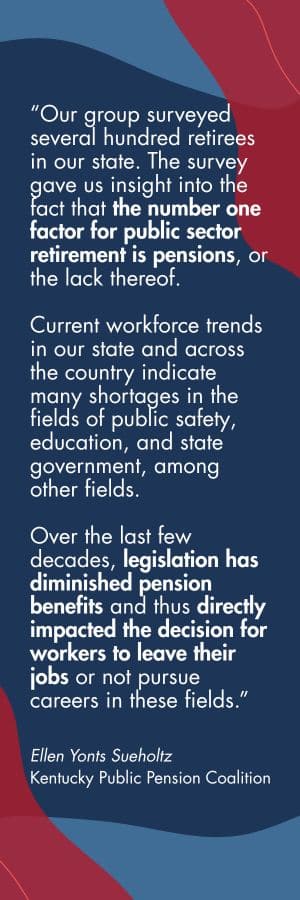
The 2026 Kentucky General Assembly will meet for 60 days and will primarily focus on negotiating the biennial budget. In recent budget years, legislators have fully funded all pension systems, including over $1 billion in supplemental funding beyond the amounts required by statute, which has put the state on a positive trajectory for legacy debt repayment.
However, the legislature’s focus on lowering the state income tax rate to zero could lead Kentucky toward a deficit, threatening future payments to the state’s pension systems. Entering 2026 with a state income tax rate of 3.5%, Senator McDaniel, chair of the Senate A&R Committee, has noted that further rate cuts will likely remain a key topic in this year’s session.
Amid this landscape, opportunities remain. Legislation has already been filed this session to move certain hazardous duty workers out of Tier 3, a hybrid plan, and into Tier 2, a traditional defined-benefit plan. In addition, lawmakers have filed a bill that will prohibit employer determination of hazardous and non-hazardous pension classifications, and a measure to narrow the public safety vacancy gap. There is also a bill aimed at adjusting an error from 2018, when the General Assembly “accidentally” decreased the retirement distribution tax exclusion to $31,110 from $41,110.
Ohio: State Legislature meets year-round.
In recent years, the Ohio Legislature has seen an increase in proposals that are slowly eroding retirement security for public employees. In 2024, the passage of Senate Bill 6 prohibited the use of Environmental, Social, and Governance (ESG) investment strategies in the state’s retirement systems. Called “the gold standard” of legislation by ALEC, the measure could cost the state billions of dollars, prioritizes political bias over fiduciary duty, and limits performance-based strategies.
Now there are several active bills threatening retirement security in the Buckeye state, including a placeholder bill with “pension reform” language in the Senate, and HB 473 in the House, which would prevent public employers from paying employee retirement contributions, a fundamental encroachment on collective bargaining rights.
The Ohio State Teachers’ Retirement System (STRS) continues to navigate negative media coverage and online commentary following several years of turmoil, including multiple lawsuits. Currently, labor leaders have secured an injunction against an 11th-hour amendment to the state operating budget proposed by Governor Mike DeWine, which reduced the number of member-elected board members from seven to three. The lawsuit is not expected to advance for several months, and the STRS board elections will proceed, with all seven positions to be filled.
Oklahoma: State Legislature convenes February 2, 2026
Almost two dozen pension-related bills, many that would directly impact the stability of Oklahoma’s pension systems, are returning from actuarial review and will be eligible for consideration in 2026. Proposals to undermine fiduciary responsibility and to add inappropriate political pressure on retirement boards by targeting foreign-adversary investments and proxy voting are also expected to resurface.
Anti-pension organizations and allied state officials have been vocal about reforming public pensions or shifting them toward defined-contribution structures. The 401(k) program for most new Oklahoma state employees poses a perennial threat to the remaining traditional pension systems. As the Oklahoma Legislature welcomes a large number of new lawmakers with shifting leadership priorities and unfamiliarity with pension issues, the coalition remains committed to advocating for and educating lawmakers within the general assembly to ensure that pensions remain the primary path to retirement security for Oklahoma’s public sector.
Wyoming: State Legislature convenes February 9, 2026
Threats to the Wyoming Retirement System (WRS) from the Wyoming Freedom Caucus are escalating quickly. Openly pursuing efforts to dismantle the current pension system in favor of a 401(k)-style model, Freedom Caucus leaders directly questioned WRS in 2025, asking, “What kind of efforts are we seeing in your department trying to move to a defined contribution rather than a defined benefit?”
In 2025, the approval of Senate File 191 set a dangerous precedent, as it would limit future fiduciary discretion. SF 191 was just one measure in a pattern of coordinated threats against WRS. The Freedom Caucus now holds a majority in the Wyoming House, the first in the nation. Supported by ALEC and the National Freedom Caucus, it continues to advance legislation that limits investment flexibility and jeopardizes the long-term health of WRS.
For daily updates, check out our Legislation Tracker on publicpensions.org!
Stay tuned for more news on what’s happening in pensions across the country. Be sure to follow us on Facebook and Instagram for regular updates, and click here to join our email list.