
“I do not have a pension to fall back on. It’s one of the reasons why people either have to hang on for extra periods of time, or why they leave state service.” Vicky O’Brien, APEA/AFT Member
With just two weeks until Election Day, Alaska’s public workers are working together to urge voters to cast their ballots for lawmakers who commit to making the years-long dream of retirement security a reality. After this year’s bipartisan success in passing legislation to reinstate a pension benefit for public employees, which outgoing Governor Mike Dunleavy vetoed, labor leaders and union members are more determined than ever to push a defined benefit law over the finish line.
Pensions Take Center Stage on the Campaign Trail
For the first time since the defined benefit plan for all public sector workers was eliminated 20 years ago, advocates in Alaska are nearing their goal of electing a supportive legislative majority and Governor.
This year, the most consequential race likely to determine the outcome of Alaska’s two-decade pension restoration campaign is the four-way contest for Governor. Among the candidates, Jonathan Kreiss-Tomkins, Bernadette Wilson, Dave Bronson, and Treg Taylor, only one has pledged their full commitment to ending the 20-year moratorium on retirement security that has wreaked havoc on the state’s ability to provide critical public services. Former state legislator Jonathan Kreiss-Tomkins, or JKT as he’s popularly known, is the sole gubernatorial candidate standing up for Alaska’s public workforce and the communities they serve by promising to support legislation that would provide a new pension plan for teachers, firefighters, police officers, and other state and municipal workers.
In an October 8th debate held in Anchorage, JKT faced scrutiny from his opponents over his support for a return to defined benefits, as Bernadette Wilson reduced last year’s massive legislative effort to pass HB 78 to a “spending bill” and made false claims about the proposal.
Kreiss-Tomkins steadfastly defended his position, saying,
“I think we owe it to our teachers, our state troopers, our other public employees, and I stand by my position as the pro-math candidate in the race. The actuarial modeling on the bipartisan legislation that passed out of Juneau this year, and that went to the Governor’s desk–only to be vetoed–showed that it would have no net liability to the state over the long term.”He continued, “This legislation, which has been highly vetted in Juneau, is actuarially and mathematically responsible, would not create an unfunded liability, and would promote increased retention–which any state employee would tell you, any teacher would tell you. I would support it.”

Beyond his support for pensions on the debate stage, JKT’s campaign has put defined benefit restoration at the top of his priority list. His campaign website states that if elected, his administration would “Create a defined benefit retirement system that ensures we don’t lose our best teachers to the Lower 48.” Even campaign literature distributed across Alaska declares that he is ready to deliver on public pensions.
Labor Unites in Support of a Pro-Pension Candidate
The Alaska AFL-CIO’s August endorsement of Kreiss-Tomkins prompted an outpouring of labor support for the pro-pension candidate. JKT then quickly racked up endorsements from 17 public and private-sector labor unions from within the state. Currently, none of the other gubernatorial hopefuls have secured a single union endorsement, in a state with a long labor tradition. While Alaska’s unique legislature operates less on party-line divisions and more on issue-based caucuses, JKT’s endorsement by multiple public safety organizations, including the Alaska Professional Firefighters Association, the Anchorage Police Department Employees Association, and the Public Safety Employees Association Local 803, represents a diverse coalition.
In September, Randi Weingarten, President of the American Federation of Teachers (AFT), joined candidates, community leaders, and members at a Town Hall meeting in Anchorage to amplify the message: Pensions are crucial to public service, and they are crucial to this election. “We need leaders who understand,” Weingarten pleaded with the crowd. “Whether it’s Social Security or a defined-benefit pension, these are foundational to a family’s wealth. These are foundational to reducing anxiety.”
President Weingarten also took the issue to her weekly video series. “Earlier this year, Alaska’s labor movement worked with a bipartisan coalition in the statehouse to pass a bill to restore public employees’ pensions. Unfortunately, the current governor vetoed that bill,” she said. “That’s why this week, we lifted up the Republican legislators who helped with that bill, as well as Alaska’s Democratic candidates for Governor and Senate, who are committed to retirement fairness for public employees.”

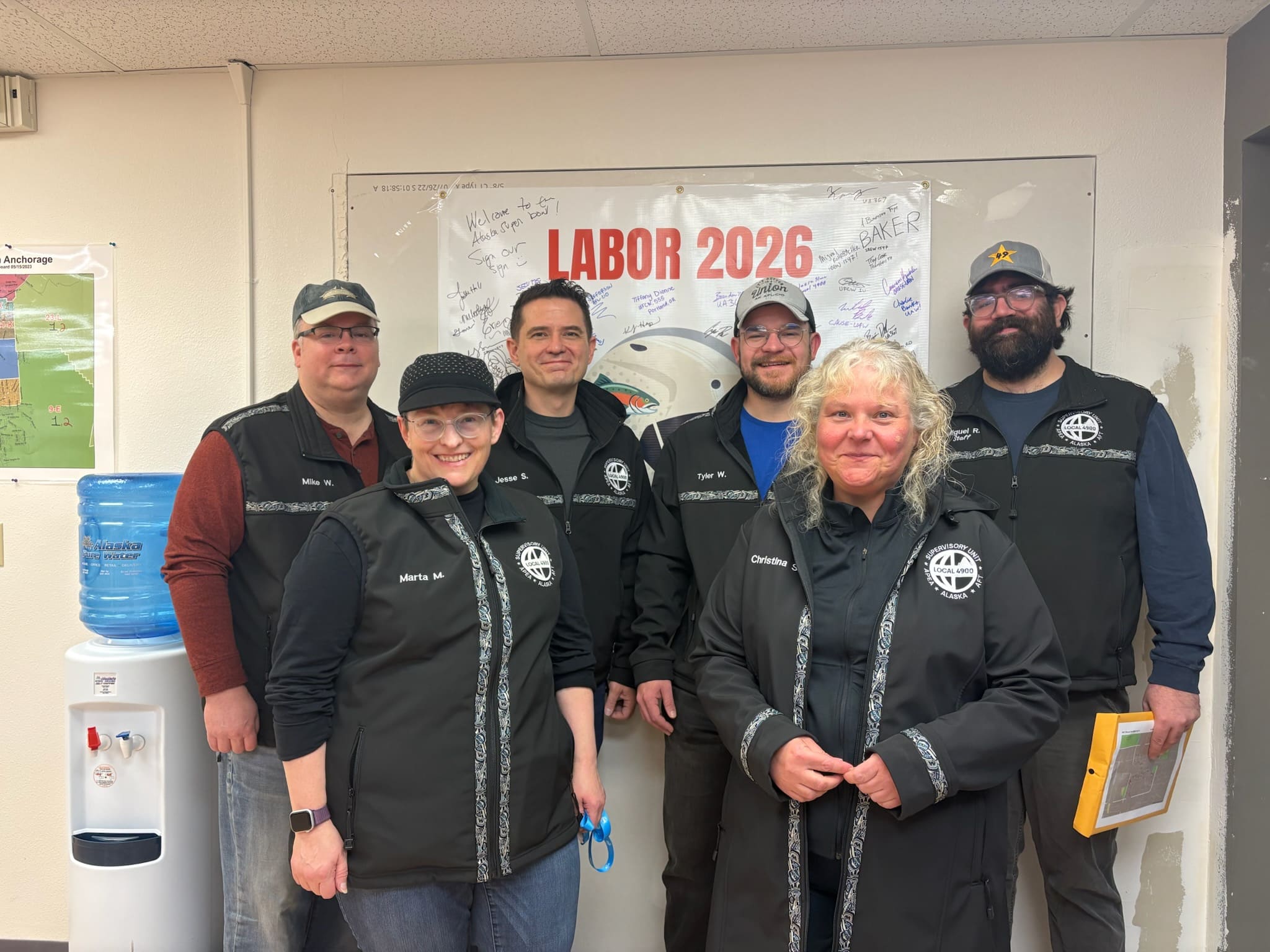
And it’s not just union leadership putting in the effort to elect a leader who will back public pensions. Rank-and-file members are going out in full force to encourage voters to show up and vote for pension-backing candidates. In addition to an ongoing phonebanking campaign, hundreds of volunteers have been walking door to door in cities like Anchorage, Fairbanks, Ketchikan, and Homer to talk with their union brothers and sisters about the significance of the current pro-pension momentum.
After the Election, Eyes Will Turn to Juneau
The labor movement, along with polling and media speculation, is growing confident about a potential November victory. The Cook Political Report recently changed its Alaska gubernatorial race prediction from a “toss-up” to “lean Democrat”–indicating that this could be the first time since 2002 that a pro-pension, labor-friendly Governor could take the reins. An AARP poll shows JKT winning by over 10% after ranked-choice tabulation. The same poll indicated 68% support for reinstating state pension benefits for public employees.
While the fate of defined benefit pensions in Alaska will largely depend on who occupies 716 Calhoun Avenue in Juneau come January, the Governor will not be the only important race on the ballot. November’s results will also shape Alaska’s legislative makeup, and both Ranked Choice Voting and a unique bipartisan legislative coalition tradition create space for unpredictability. Currently, a labor-allied bipartisan coalition holds the Senate by a 14-6 margin, and the House 21-19. The state AFL-CIO has endorsed a full slate of labor-aligned candidates.
Early Voting is already underway, but the results may not come in quickly. Some expect it to take weeks to know the final winners. Even with favorable outcomes, restoring pensions will require sustained work in Juneau next year. The 35th Alaska State Legislature convenes its First Regular Session on January 19, 2027.
For the public employees who have waited two decades for this moment, this election offers hope that a more secure retirement is finally within reach.